How it works
One pipeline, any size crew.
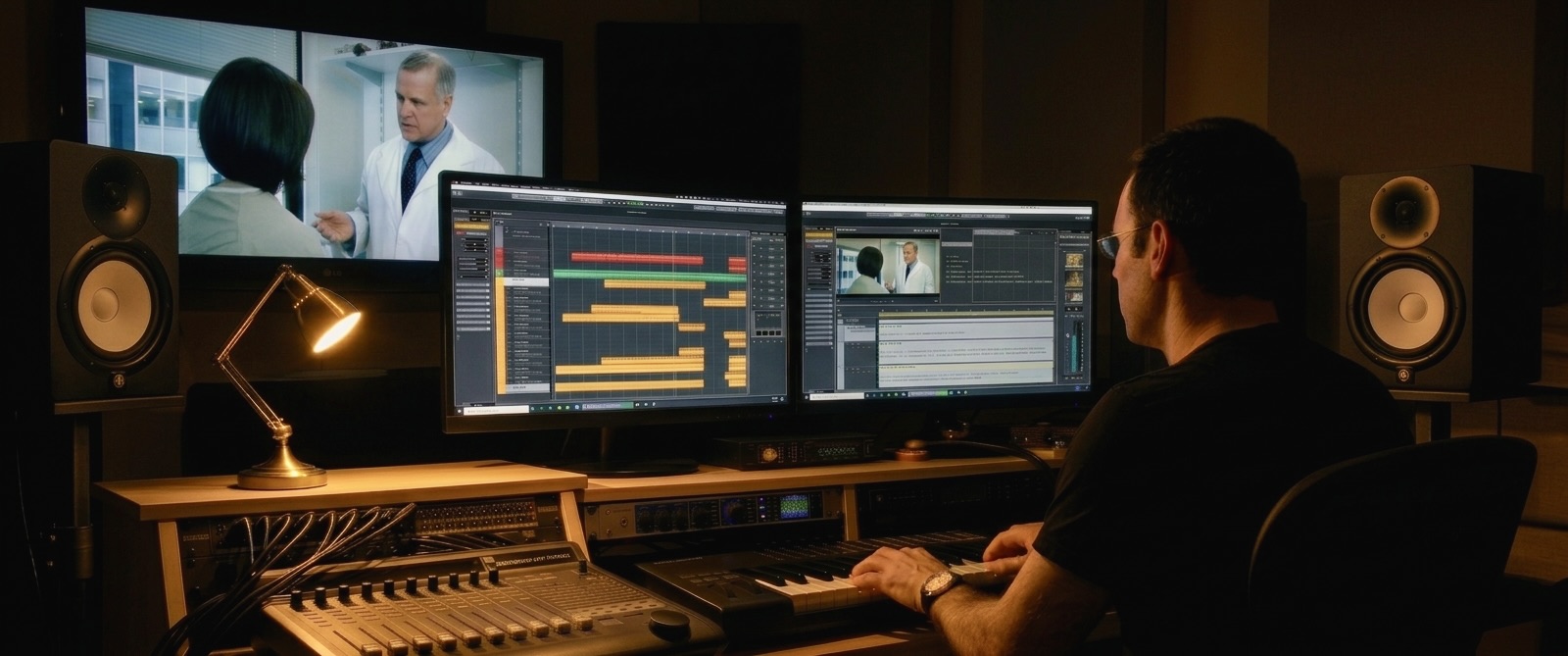
Most productions hand your project across four companies. A production house shoots it, an edit house cuts it, a VFX vendor fixes it and a post house finishes it – and the intent leaks out at every handoff.
Equipment
Cameras. Work here has been shot on ARRI, on Blackmagic professional bodies and on Sony CineAlta. Retina ran on a Sony CineAlta HDW-F900R, with a Phantom HD for the high-speed work and a DSLR for the spaces nothing bigger would fit into. An Apple iPhone gets used for special cases – a shot where nothing larger can physically go, or where the look of it is the point. Ten years ago that would have been a compromise; the technology has moved, and it is not one now. The package gets specced per job, so the format follows the look the picture needs and the budget it has.
Sound. Mixes are delivered in 5.1 surround, with M&E tracks – music and effects, dialogue stripped out – so a film can be dubbed into another language without going back to the stems. Broadcasters and distributors ask for that as a matter of course, and it is the kind of deliverable that holds up a release when nobody specced it at the start.
- Cameras
- ARRI · Blackmagic · Sony CineAlta
- Specialist
- Phantom high-speed · DSLR for tight spaces · Apple iPhone for special cases
- Audio delivery
- 5.1 surround · stereo · M&E tracks for film and television
- Picture delivery
- 4K as standard, 6K where the project calls for it, in the formats and aspect ratios you need
Here the person who directs your project is the person who shoots it, scores it, cuts it and finishes it, because that is one person. Fifteen credited departments across the filmography, one pipeline, no handoffs. The music goes out under the name 10UTO.
None of that means working alone. Scallop Pond ran with a cast and crew of more than a hundred; every film here has had actors, locations and people on the floor. Crews scale to what the picture needs, and if someone is better at a job than I am, I would rather hire them than fake it. What does not change is that one person stays responsible from the first page to the final master – so nothing gets lost being re-explained to the next company.
Covering that much myself is a lever, not a preference. On a commission it keeps your budget on the screen rather than in four sets of overheads, because the departments you would otherwise be paying four companies to coordinate are already in one place. On work closer to my own, it keeps the intent intact – the person who decided what a scene means is still there at the mix. Which of those matters more is a decision we make per project, not a rule I bring to it.
My pipeline is current, and machine learning is part of it – treated the way I treat any collaborator: briefed, directed, and kept only where it earns its place. It carries cleanup and iteration. It does not decide anything about your film. Here’s where I stand on that.
Everyone has the same tools now, which is why the tools are no longer the difference. A prompt is easy to write. Deciding which of forty takes is the one, holding a shot two seconds past comfortable, hearing that a scene is a beat too long before an audience has to tell you – that is the work, and it is what twenty years buys. You are not hiring access to software. You are hiring the judgement that decides what to do with it.
I take on a limited number of commissions at a time – if the calendar is full I’ll tell you straight away.
Capabilities
Music Videos
Concept through delivery. Narrative, performance, or something stranger – developed with the artist, not handed to them. I shoot it, cut it and finish it, so what you approve is what ships.
- Treatment
- Direction
- Cinematography
- VFX
- Finishing
Commercial & Branded
Spots, brand films and campaign content shot with the same coverage discipline as narrative work. Built to cut down for social without looking like an afterthought.
- Spots
- Brand film
- Social cutdowns
- Product
Post & VFX
Full post services for outside projects, original score included. Retina’s visual effects – set extensions and all – were built entirely in-house, and presented at SIGGRAPH. See the effects work.
- Editorial
- VFX
- Set extension
- Color
- Sound
- Original score
Documentary & Other Media
Short-form documentary, event films, title sequences, and the projects that don’t fit a category. If it’s moving pictures and it’s interesting, ask.
- Short doc
- Titles
- Event
Visual effects
VFX built in the same room as the film
Every effects shot in Retina was built in-house, by the same person who shot the plates – which is the whole reason they hold up. The work was presented to the computer-graphics industry at SIGGRAPH in 2016. It is available on its own, for other people’s films.
Destruction & Simulation
The Manhattan Bridge collapse: the real bridge shot on location, its centre painted out, modelled back in Cinema 4D, then fractured and brought down with rigid body dynamics. The cables were the hard part – hair linked to splines inside sweep objects, constrained and run with spline dynamics so they whip loose as the span fails.
- Rigid body
- Fracture
- Spline dynamics
- Cleanup
Set Extension & Environments
Rooftops, skylines and interiors that do not exist, cut in beside plates that do. The aerial over the rooftop on Retina was assembled from reference shot by hand, with the renderer chosen for that shot because it matched the live-action plate better than the default. Audiences took it for a real helicopter.
- Matte painting
- Modelling
- Lighting
- Lookdev
Compositing & Finishing
Integration is where effects are won or lost: grain, edges, motion blur and grade matched until the seam disappears. Compositing in After Effects, straight into the same colour and sound pipeline that finishes the picture, so nothing is handed to a vendor who has never seen the film.
- Comp
- Roto & paint
- Grain match
- Grade
- Built with
- Maxon Cinema 4D · the Adobe suite · DaVinci Resolve
- Edit & grade
- DaVinci Resolve, and whichever editing application the job already runs on
- Presented at
- SIGGRAPH 2016 · visual effects and set extensions from Retina
- Delivery
- 4K as standard, 6K where the project calls for it, in the formats and aspect ratios you need
Process
Brief to delivery, in 6 steps
Conversation
You send the brief – what it is, when you need it, roughly what you can spend. I’ll tell you within a day or two whether I’m the right fit and whether the calendar allows it. No pitch theatre.
Treatment
A written treatment with references, a shot approach and a schedule. You approve the idea before anyone books a camera. Revisions here are cheap; revisions later are not.
Prep
Casting, locations, crew, kit and a shot list. Long prep is the single biggest reason my shoot days stay short and my budgets hold.
Shoot
Lean crew, thorough coverage. The director is on the camera, so what gets shot is what the edit needs – not a pile of footage someone else has to rescue.
Post
Editorial, visual effects, color, sound and mix, all in-house. One round of notes is included at picture lock, and you see the same person the whole way through.
Delivery
Masters in the formats and aspect ratios you need, plus social cutdowns and captions if they’re part of the job. Project files archived at my end.
Working together
Let’s make something
The more of this you can answer up front, the faster I can tell you whether I’m the right fit and what it will cost. Nothing here is compulsory except a way to reach you.
Let’s talk
Have something worth shooting?
Music video, commercial, or a feature that needs a director who can also finish it – tell me what you’re making.
Get in touch